Tracing the Development of Random Number Algorithms Used in Contemporary Roulette Software Across Global Markets
Harper Griffin · Aug 20, 2026

Tracing the Development of Random Number Algorithms Used in Contemporary Roulette Software Across Global Markets
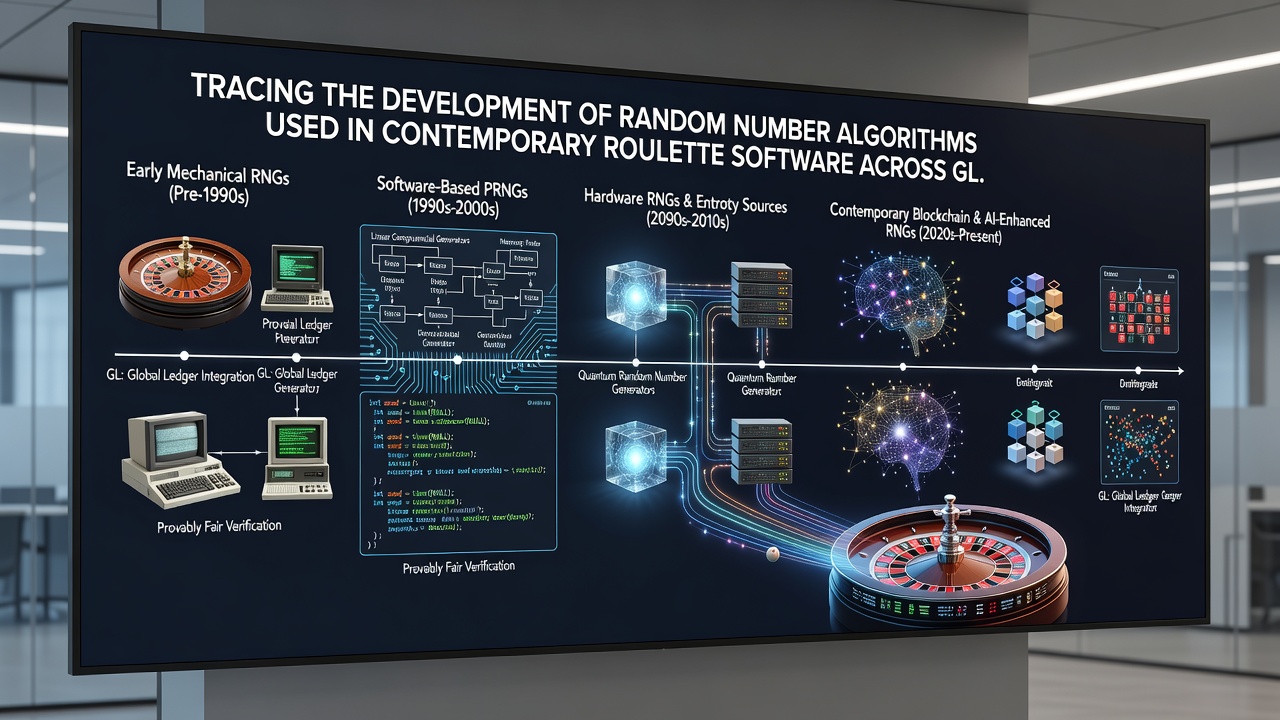
Random number algorithms in roulette software trace their roots back through decades of technological shifts that moved gaming from physical wheels to digital platforms operating in markets worldwide, and this progression reflects ongoing efforts by developers and regulators to balance fairness with computational efficiency while meeting certification requirements that differ by region. Early mechanical systems relied on physical randomness, yet the introduction of electronic roulette in the mid-twentieth century prompted engineers to explore pseudorandom number generators that could simulate outcomes at scale, and those initial implementations often drew from linear congruential generators documented in academic literature during the 1960s.
Foundations in Early Computing and Gaming Hardware
Researchers in the 1970s adapted algorithms such as the middle-square method for early casino machines, although limitations in period length soon became apparent when sequences repeated too quickly under high-volume play, and this led programmers to integrate better options like the Mersenne Twister by the late 1990s because its long period and statistical properties suited the demands of continuous online sessions. Observers note that hardware random number generators began appearing in land-based terminals around the same time, drawing entropy from physical sources such as thermal noise or radioactive decay, while software-based alternatives remained dominant in remote markets where cost and scalability mattered more.
By the 1980s several manufacturers had begun testing their generators against statistical suites developed at institutions including the National Institute of Standards and Technology, and those evaluations helped establish baseline expectations for uniformity and independence that later influenced global standards. Data from industry reports indicate that adoption accelerated once personal computers entered homes, creating demand for roulette simulations that could run locally without constant hardware intervention.
Shift Toward Cryptographic Security in Digital Markets
The rise of internet-based casinos in the 1990s forced developers to strengthen algorithms against prediction attacks, and cryptographically secure pseudorandom number generators such as those built on AES or SHA functions gained favor because they resisted reverse-engineering attempts that simpler methods could not withstand. European operators, for instance, integrated these approaches to satisfy testing protocols that required both statistical randomness and resistance to state compromise, whereas Asian markets often emphasized throughput for high-traffic mobile platforms, leading to hybrid systems that combined hardware entropy with software post-processing.
Standards bodies in Canada and Australia published guidelines during this period that referenced specific algorithm classes, and compliance documentation shows operators updating their roulette software accordingly to maintain licensing across multiple jurisdictions. What's interesting is how the same core techniques sometimes received different scrutiny depending on whether regulators prioritized theoretical proofs or empirical test results from large sample sets.
Contemporary Implementations and Regional Certification Practices
Contemporary roulette software across global markets typically employs a layered architecture where an initial entropy source feeds into a deterministic generator that produces the visible wheel outcomes, and certification laboratories verify both layers through extensive testing that includes dieharder suites alongside custom gaming-specific evaluations. In the United States, tribal gaming commissions reference federal guidelines that align with NIST publications on random bit generation, while operators in Latin American markets often follow frameworks developed by local gaming authorities that emphasize audit trails for every spin sequence.
Research from university-affiliated labs has examined the performance of newer constructions such as those based on elliptic curve methods, and findings published in technical proceedings reveal improvements in both speed and resistance to side-channel analysis compared with earlier designs. As of August 2026 several platforms have incorporated quantum-resistant primitives in response to emerging regulatory consultations, although widespread deployment remains gradual because existing certified systems continue to meet current operational thresholds.
Market data compiled by international trade groups show that the majority of licensed roulette titles now undergo at least annual re-testing, and updates to underlying algorithms occur when statistical anomalies surface during ongoing monitoring rather than through scheduled overhauls. Those who've examined certification archives note that differences in test sample sizes across regions create varying levels of assurance, yet the core requirement for unpredictability remains consistent.
Conclusion
The trajectory of random number algorithms in roulette software demonstrates a steady refinement driven by computational advances, regulatory expectations, and cross-border operational needs, and this evolution continues to shape how platforms deliver consistent experiences in diverse markets. Continued collaboration between developers, testing labs, and oversight bodies ensures that new implementations address both legacy compatibility and forward-looking security considerations without disrupting established player environments.